A remote MCP server with OAuth 2.1 and per-user permissions
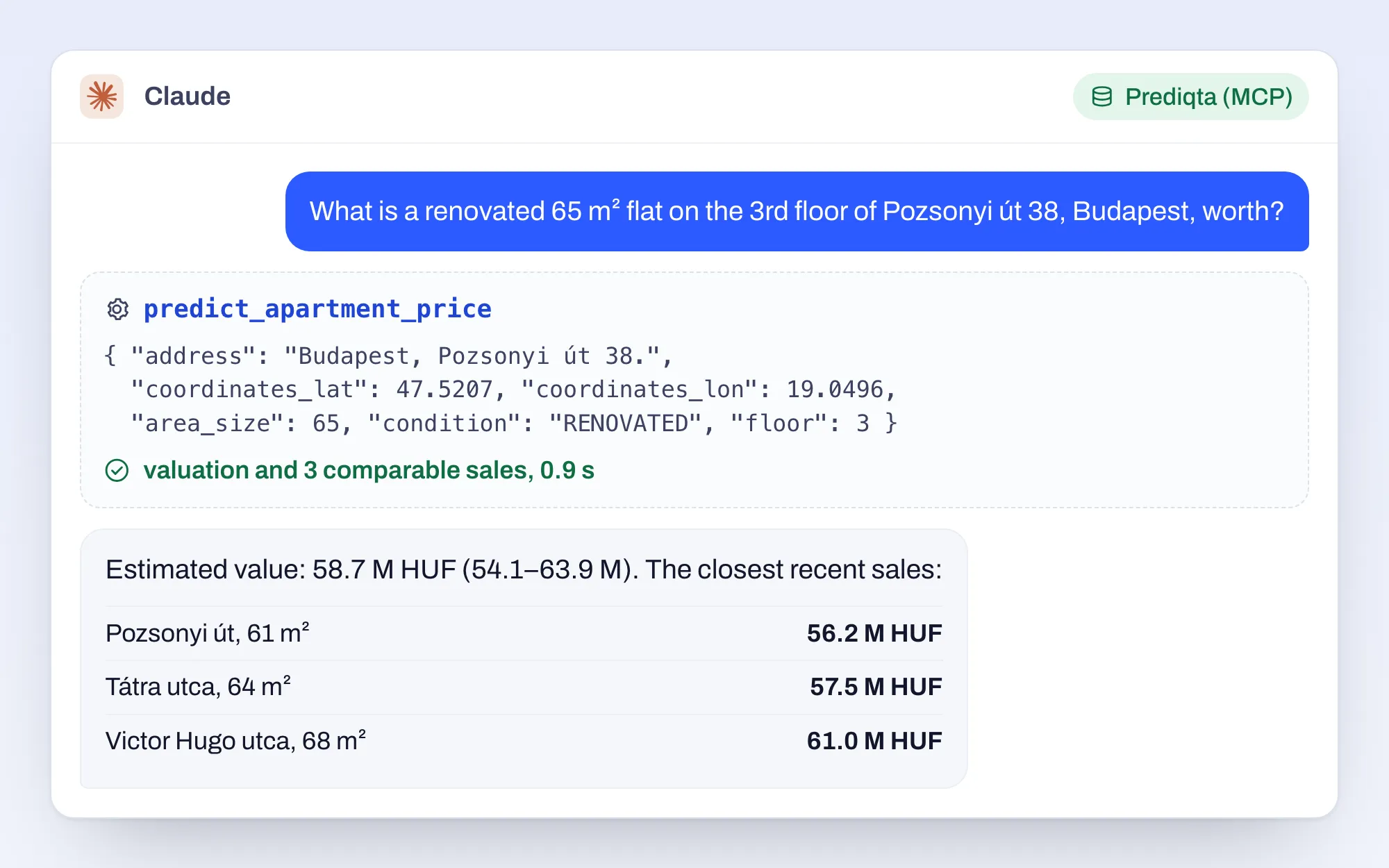
How we connected Prediqta’s real estate data to Claude without writing a second backend or a second copy of the permission rules.
Language models get the headlines, but a lot of value still comes from classic machine learning on your own numbers: how much to bake, what a property is worth, which customer is about to leave. We build these models, prove them on your history before anyone relies on them, and run them where your team already works.
You need history: typically at least a year of data for anything seasonal, and a clear decision the forecast will change.
A forecast nobody acts on is a dashboard. We design backwards from the decision: what someone will do differently, and when.
How the model would have performed on past periods it never saw, in units your team cares about.
A service or scheduled job that feeds your systems, with retraining built in.
Why each prediction came out as it did, where the decision needs it.
Accuracy against actuals and data drift, with alerts.
A simple screen, a report or an API, wherever the decision is made.
Features, assumptions and known limits, written for the next engineer.
In production
Bakery demand forecasts with about one item of error at the 30-minute horizon, refreshed every ten minutes. Property valuation and rent models judged by median percentage error on recent listings, with the contribution of every feature group tested by ablation.
How we connected Prediqta’s real estate data to Claude without writing a second backend or a second copy of the permission rules.
Often it is a start. What matters is history, consistency and a clear target. We check this in the first week.
Rarely for the forecast itself: gradient boosting and time-series models are usually more accurate and far cheaper. LLMs help around it, explaining results, reading unstructured inputs and writing reports.
We agree on a metric that matches the decision, then backtest on periods the model never saw. You see the error in your own units before it goes live.
When decisions are sequential and the environment can be simulated, such as hedging or inventory control. We spent two years on reinforcement learning for options hedging and know its pitfalls, especially overfitting to the backtest.
A few sentences are enough. We reply within one business day, usually with a couple of questions and a suggestion for a 30-minute call.